

Limb Lengthening & Deformity Correction in Türkiye
Thinking About Limb Lengthening?
Start With Clarity.
Your Goals Are Personal. Your Options Should Be Too.
Explore limb lengthening and deformity correction with greater clarity, based on your individual case.
We work with orthopedic teams experienced in limb lengthening and deformity correction, supporting patients through each stage of the journey.
Tell Us About Your Case
Share a few details and we'll help you explore suitable next options.
Step 1 of 2: Your case
Limb lengthening and deformity correction are orthopedic procedures used to address limb-length differences, bone deformities, alignment problems, and selected height-lengthening goals. Treatment typically involves carefully planned correction or gradual lengthening of the bone, allowing new bone to form as the limb is progressively adjusted. The exact technique and recovery process vary according to the patient's anatomy, goals, bone and joint health, and rehabilitation needs.
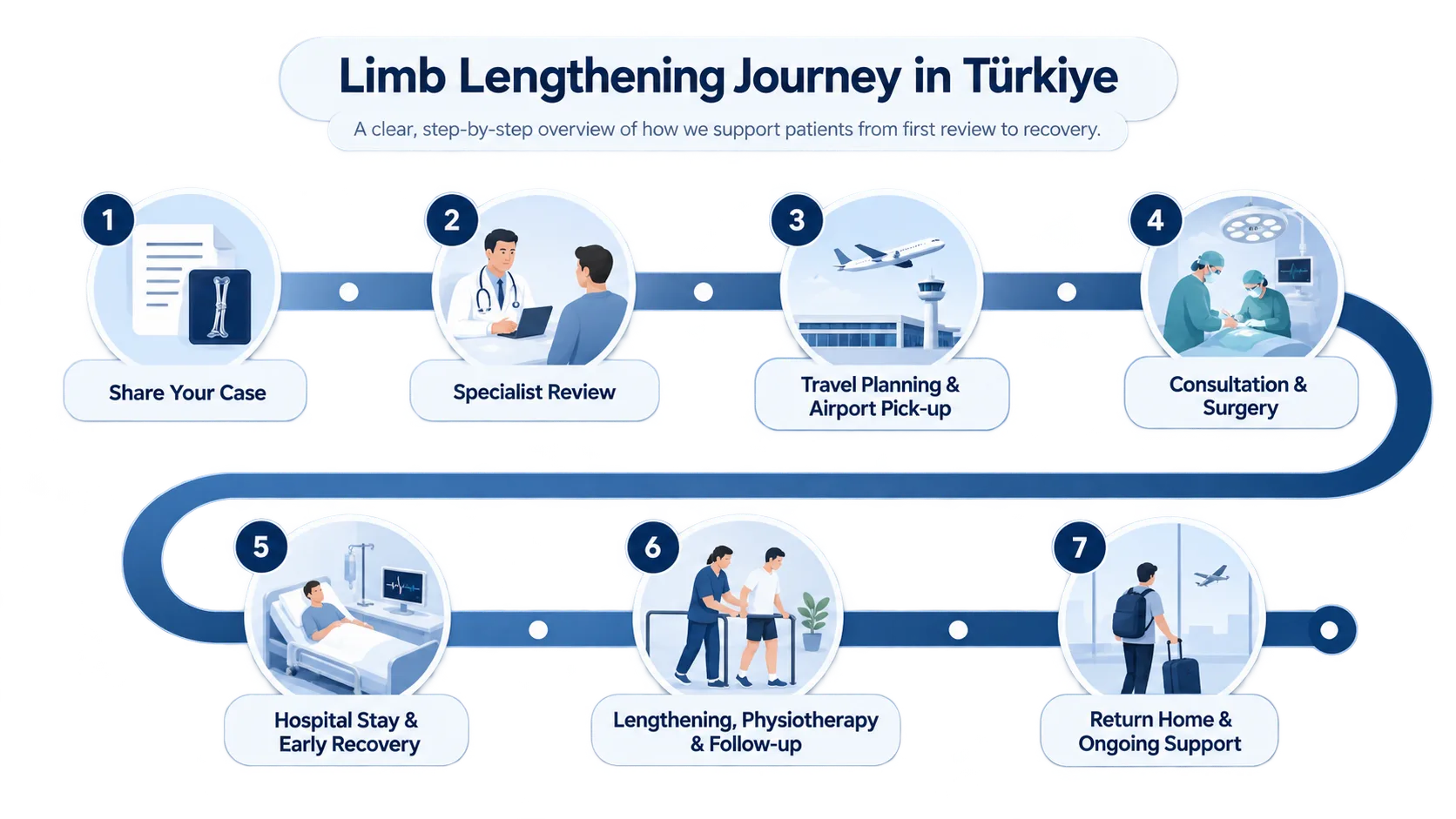
Your Limb Lengthening Journey, Step by Step
From initial assessment to bone healing and rehabilitation, limb lengthening is a carefully planned process tailored to each patient.
Assessment & Planning
Every limb lengthening journey begins with careful assessment and planning. Imaging, bone alignment, joint health, individual goals and rehabilitation needs are considered before a treatment approach is discussed.
Surgery
During surgery, the bone is carefully divided and a lengthening system is positioned. Depending on the individual case, treatment may involve an internal lengthening nail, external fixation or another reconstructive technique.
Gradual Lengthening
After surgery, the bone segments are gradually separated in small, controlled increments. This process — known as distraction osteogenesis — allows new bone to form in the space while surrounding tissues progressively adapt.
Consolidation & Rehabilitation
Once the planned lengthening or correction is reached, the newly formed bone needs time to strengthen and mature. Follow-up and structured rehabilitation remain important for joint mobility, muscle function and a safe progression through recovery.
Ready to Discuss Your Case?
Start by telling us about your case, or contact us directly through the channel you prefer.
Prefer to contact us directly?
For medical reports and scans, please use our case form.